
From Static Signs to a Dynamically Managed Curb:
Lessons from Philadelphia and Sydney
The curb is one of a city’s most undervalued and most contested assets.
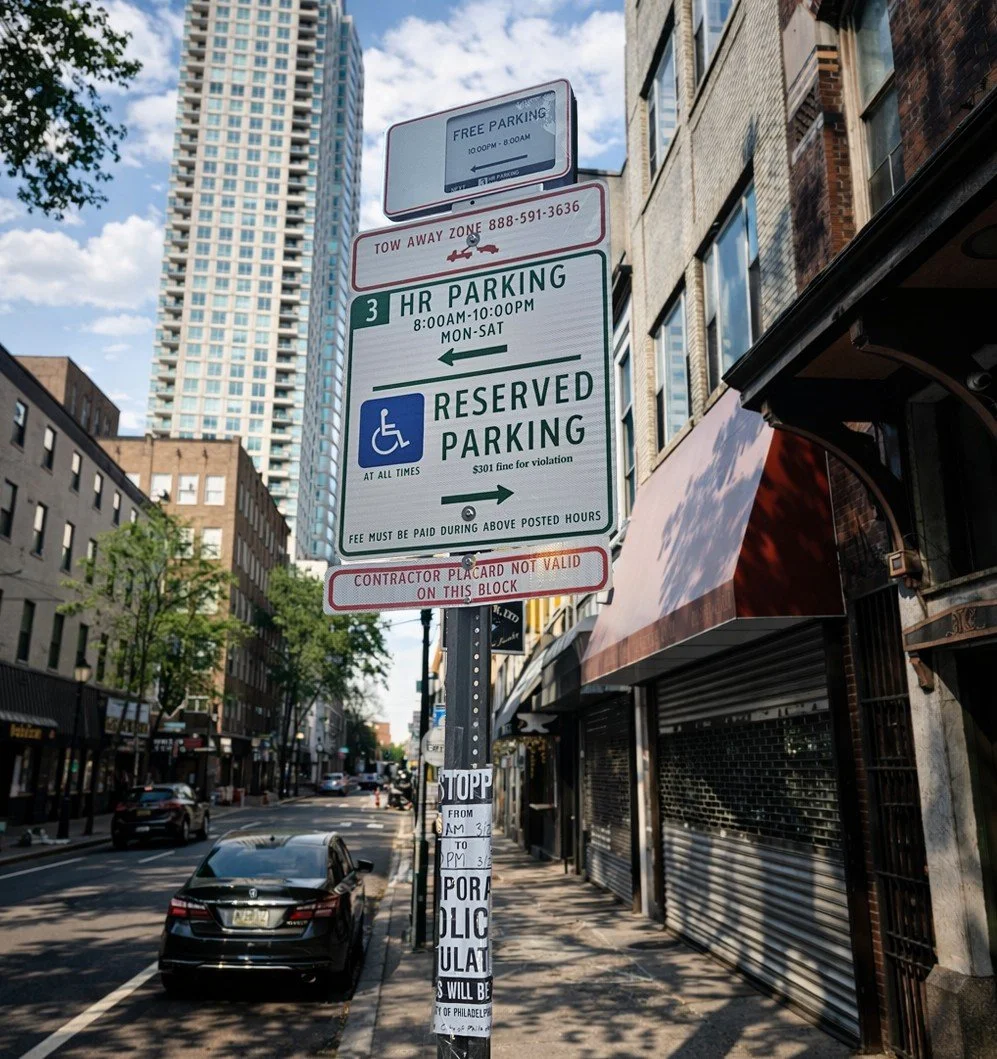
At different times of the day, the same section of curb may support parking, accessible access, passenger loading, deliveries, construction activity or a temporary event restriction. Yet the methods traditionally used to communicate these changing conditions have remained largely static.
Temporary paper notices are frequently installed manually. They can be damaged by weather, obscured by other signs, mounted inconsistently or removed too late. In some cases, they may simply disappear before the restriction takes effect.
The result is uncertainty for drivers and an operational challenge for city authorities: How can an agency be confident that the correct message is visible at the curb, at the correct time?
Philadelphia’s recent Digital Right-of-Way and Mobility Improvement Project provides an important step towards answering that question.
Digitising Philadelphia’s right-of-way
The City of Philadelphia’s recent project explored how right-of-way assets, policies and temporary conditions could be digitally managed and communicated.
The wider initiative included curbside data specification, management software, digital curbside signage and signal priority technology. Within the digital signage workstream, the City worked with project partners SenSen and Mercury Innovation to scope, site, install and test solar-powered ePaper signs.
The City procured 40 signs, deploying 38 across the pilot area and retaining two for testing and replacement purposes. The displays used cellular communications for remote content updates and a management portal through which individual devices could be managed and monitored.
The objective was not simply to replace one sign with another. It was to reduce the amount of interpretation required from someone arriving at the curb.
Rather than asking a driver to read several overlapping regulations and work out which one currently applies, a digital sign can communicate:
the condition that applies now
the next upcoming condition and/or
any temporary override created by an event, closure or permit
The pilot identified this reduction in interpretation burden as one of the principal benefits of digital signage. It also recognised the importance of presenting information physically at the point of decision, without requiring every user to have a smartphone, connected vehicle or access to a digital application.
When the event plan changes, the curb must change with it
One of the strongest demonstrations during the pilot occurred when an event-day plan changed.
A temporary no-parking area was no longer required. Under a conventional paper-based process, responding to the change could have involved contacting field personnel, locating the affected notices, attending site at multiple locations and physically removing or replacing each message.
The digital signs allowed the condition to be changed quickly and precisely.
This was a relatively simple operational adjustment, but it illustrates a much larger shift. Cities are no longer limited to publishing a restriction and hoping the message remains correctly displayed until someone returns to remove it.
A digitally managed system provides greater assurance that:
the change has been issued
the intended signs and locations have received it
the correct message is being displayed and
outdated information is no longer being presented to drivers
It transforms curbside communication from a largely manual activity into a trackable operational process.
Lessons carried from Sydney
Mercury Innovation’s experience supporting special-event deployments in Sydney informed several important principles applied to the Philadelphia project.
Show what applies now and what comes next
A curb condition rarely changes without a transition.
Displaying the current condition gives drivers immediate certainty. Displaying the upcoming condition helps people understand what will change and when. This is particularly valuable ahead of special events, temporary clearways or construction activity, where advance warning can help users make better decisions before a restriction begins.
Keep the message simple
Digital technology does not remove the need for good communication design.
Drivers often have only a few seconds to interpret a curbside instruction. The strongest messages use clear language, strong visual hierarchy and only the information needed to make an immediate decision.
A digital sign should make the rule easier to understand not reproduce every line of a complex regulatory notice on a screen.
Confirm the message remotely
One of the most significant advantages of connected signage is operational visibility.
With temporary paper systems, an agency may know that an installation was scheduled, but not necessarily whether every notice remains upright, visible and undamaged.
Connected signs allow operators to monitor individual devices remotely. This provides a higher level of assurance that the intended message is present on the day it is needed.
Treat placement as part of the communication
A correct message is ineffective when it is hidden, mounted inconsistently or lost due to poor installation processes.
The Philadelphia project used curb-policy and asset data to identify locations where multiple conditions made dynamic displays most useful. The siting process also considered the condition of existing poles, solar access and the complexity of regulations along each block face.
This reinforces a lesson familiar from Sydney: the success of a message depends not only on what it says, but on whether users can see and understand it at the point where they must act.
From digital signs to a digitally manageable curb
The long-term opportunity extends beyond replacing temporary paper notices.
When curb regulations are structured as data, they can potentially be shared across permitting platforms, city management systems, public-facing applications, navigation services and physical signs.
That creates the foundations for a curb that can respond more effectively to:
special events
construction activity
accessible parking requirements
loading and delivery demand
emergency conditions and
changing transport priorities
The Philadelphia report is appropriately cautious about the next steps. Stage 1 established a proof of concept rather than a fully integrated citywide operating system, and formal before-and-after compliance outcomes were not measured during the project period. The report also identified opportunities for future development, including deeper workflow integration, display and mounting improvements, and greater replacement of overlapping analogue signage.
Those lessons are valuable. They show that effective curbside digitisation is not achieved by installing screens alone. It requires reliable data, clear operational workflows, appropriate siting, thoughtful message design and integration with the systems that create and approve curbside conditions.
As Mercury Innovation Managing Director Enrique Esquivel observes:
“The curb is among a city’s most valuable and contested public assets, yet its use is still governed through largely static systems. Enabling it to be managed dynamically transforms the curb from fixed infrastructure into a responsive platform for access, mobility and changing urban needs.”
Philadelphia’s pilot demonstrates what becomes possible when the physical curb is connected to a digital management process.
The result is not simply a better sign. It is a more responsive, visible and accountable way of managing one of the city’s most important public assets.
For municipal parking authorities, transport agencies and smart-city teams, the next opportunity is to consider which parts of the curb remain constrained by static communication—and what could be unlocked by making those conditions digitally manageable.
Contact Mercury Innovation to discuss how dynamic ePaper signage can help unlock the potential of your curbside network.